
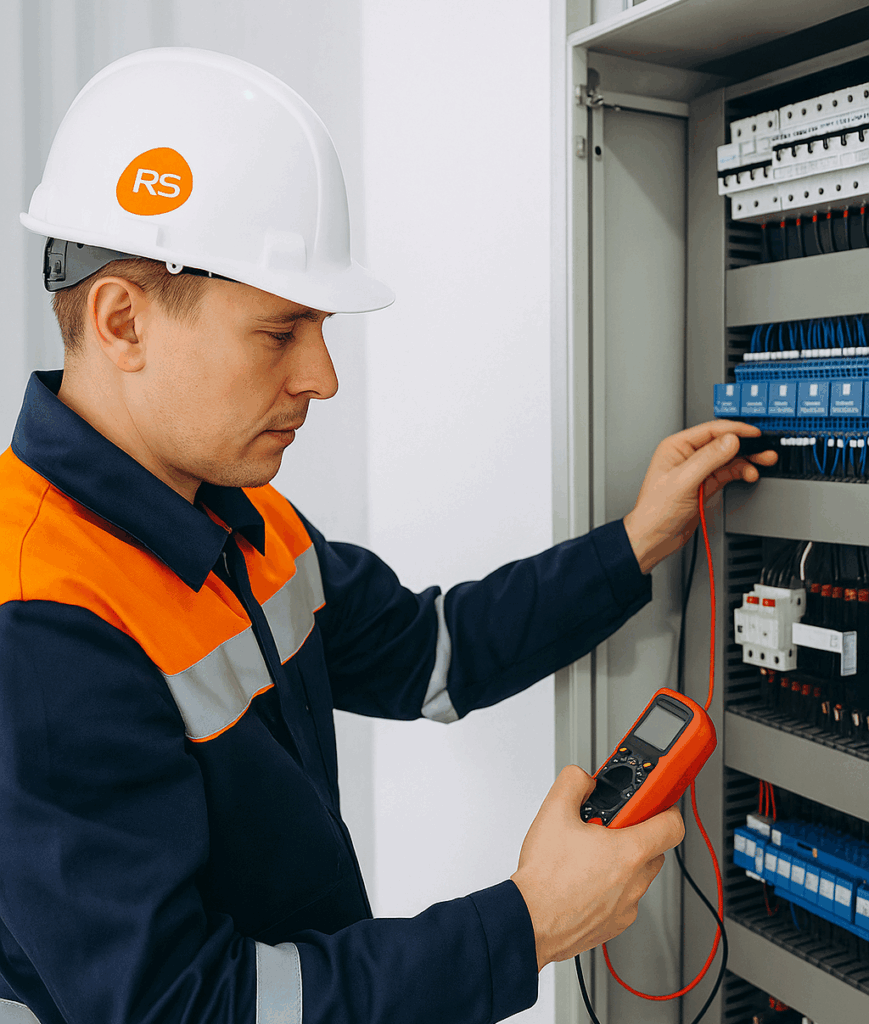
Electrical safety is the foundation of any organisation. Whether it is an office, factory or healthcare facility: a malfunction or failure can lead to dangerous situations, high costs or even downtime of crucial processes. The NEN 3140 inspection was developed for exactly this reason.
In this blog, we explain what this inspection entails, why it is legally and practically indispensable, and why healthcare institutions, dental practices, private clinics and veterinary clinics in particular cannot do without it.
What is a NEN 3140 inspection?
The NEN 3140 standard describes the requirements for safely operating and managing electrical installations and equipment up to 1,000 volts AC voltage.
A NEN 3140 inspection checks whether your electrical installation:
- Meets safety standards
- Correctly maintained is
- Does not pose a risk to employees, patients or visitors
The inspection consists of a visual inspection, measurements, tests and a clear report with recommendations.
The risks without inspection
When a plant is not inspected periodically, organisations face major risks:
- Fire hazard - poorly connected cables or overloading can lead to fire.
- Liability - in the event of an incident, the organisation or director may be held personally liable.
- Production downtime - an outage can shut down processes for days.
- Being uninsured - many insurers do not pay out if a current inspection has not been carried out.
Especially for the healthcare sector
In healthcare facilities, dental practices, private clinics and veterinary clinics, a reliable electrical installation is even more important. After all, this often involves equipment that directly affects the health and safety of patients or animals.
Think of ventilation equipment, operating lamps, sterilisers or ICT networks. An interruption in the power supply can have immediate consequences for healthcare provision. Therefore, a periodic NEN 3140 inspection is essential to reduce risks and ensure continuity.
Examples of measurements during an inspection
During a NEN 3140 inspection, we perform various checks and measurements, including:
- Resistance measurements - checking that cables and connections have good conductivity.
- Voltage differences - check for dangerous voltage differences between metal parts.
- Leakage currents - measure that no unwanted electrical currents are leaking that could cause danger or malfunctions.
- Touch voltage - check that touching metal parts remains safe even in the event of a fault.
- Insulation resistance - testing whether cables and equipment are properly insulated and pose no risk of breakdown.
- Firmness of contacts - check whether sockets and connection points clamp firmly enough.
- Field strength - measuring electric or magnetic fields in the environment.
- Earth leakage circuit breakers - test whether earth leakage circuit breakers intervene correctly and in time.
- Practical test ("walking test") - checking the installation during normal operation and loading.
- Floor resistance - checking whether floors are sufficiently insulating or conductive, depending on the space.
- Circuit impedance - measuring whether the protections (fuses, circuit breakers) react quickly enough in the event of a short circuit. and expand the distribution cabinet and sub-divisions.
Standards and guidelines
When carrying out inspections and installations in medically used areas, we always follow the applicable standards and guidelines, including:
- NEN 3134:1992 - Safety requirements for low-voltage electrical installations in medical purpose rooms.
- NEN 1010 (various editions, most recently 2015/C2:2016) - Safety provisions for low-voltage installations, Dutch implementation of the HD-IEC 60364 series.
- NEN 3140:2011+A3:2019 - Operation of low-voltage electrical installations.
- NEN-EN-IEC 60601-1:2006 (with supplements) - Medical electrical equipment, general requirements for basic safety and essential performance.
By strictly following these standards, healthcare facilities can be confident that their electrical installations are safe, reliable and future-proof.
Legal obligation and insurance
According to the Working Conditions Act, an employer is obliged to ensure a safe working environment. This means that electrical installations must be inspected periodically. In addition, many insurers require a current inspection report to maintain coverage in case of damage.
Benefits of a NEN 3140 inspection
- Safety guaranteed for employees, patients and visitors
- Preventing breakdowns and failures through timely maintenance
- Complying with laws, regulations and insurer requirements
- Saving costs by identifying problems early on
Conclusion
A NEN 3140 inspection is not only an obligation, but also an investment in safety and continuity. Especially in the healthcare sector, where failure of electrical installations can directly affect lives, it is indispensable.
At RS Installatiegroep B.V., we carry out NEN 3140 inspections expertly and independently. Our reports are clear, with recommendations and meet all the requirements of insurers and regulators. So you are assured of safety and security.
📞 Want to know more or schedule an inspection right away? Contact us via info@installatie-groep.nl or call 085 060 0819.